

Hauler & Hermann
Back to knowledge
Technical Insight

Slot Fill Factor: How Thin a Slot Liner Can Be, Including Hairpin Stators

Yannick Wille

By Yannick Wille, Managing Director

November 17, 2026

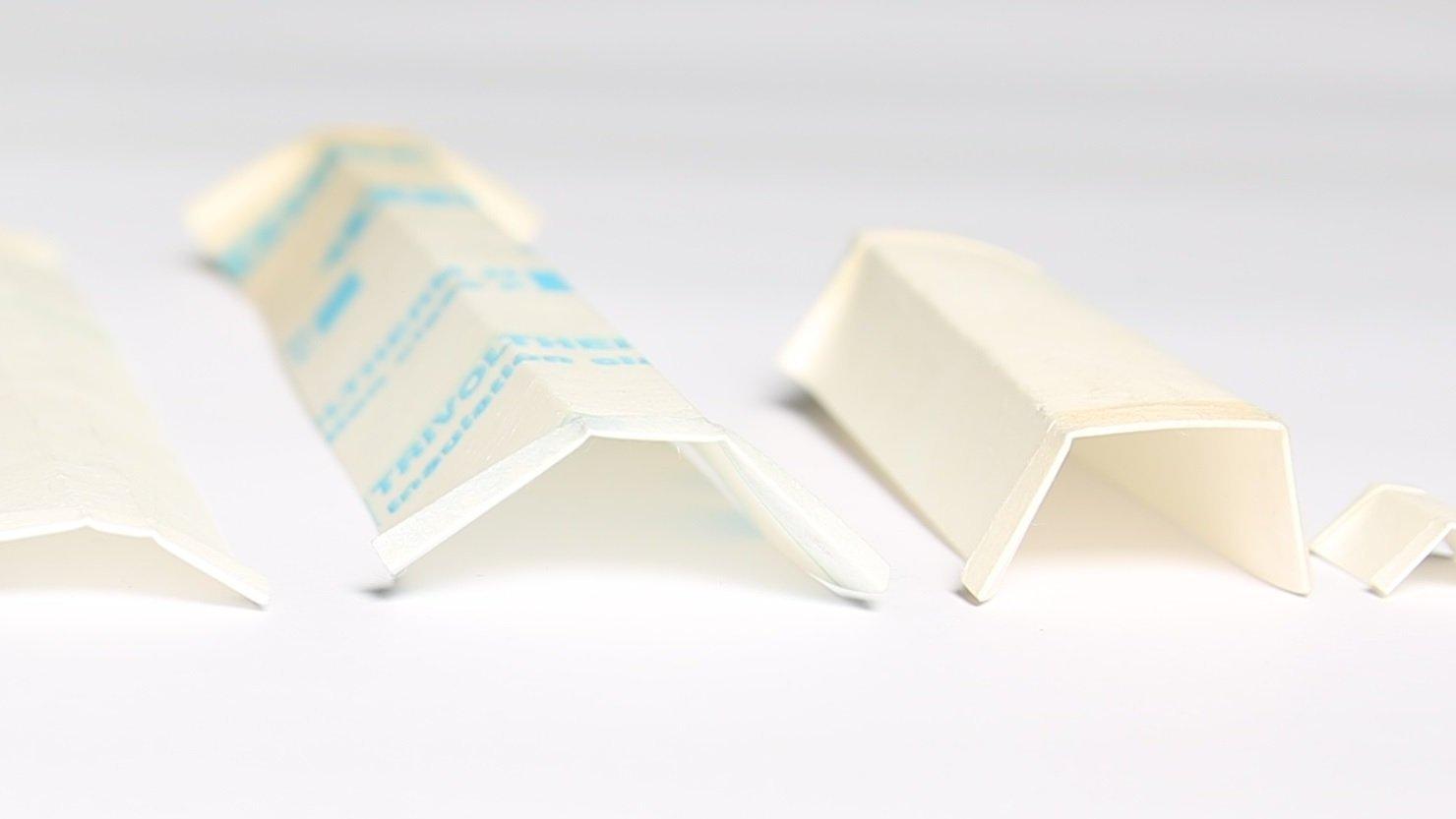
Several folded slot liners as U-profiles on a white background, one with blue print

The slot fill factor, also called slot fill ratio, is the ratio of the conductor cross-section in the slot to the available slot cross-section. Depending on the definition, either the bare copper or the wire including its enamel is counted. The higher the slot fill factor, the more copper the stator holds within the same envelope. Because the slot liner also takes up space in the slot, it should be as thin as possible while remaining electrically and mechanically reliable.

This article is written for design engineers and buyers at motor and generator manufacturers. It shows what besides copper takes up space in the slot, where the limit for a thinner slot liner lies, when a thinner laminate pays off, and why material thickness, geometry and dimensional accuracy carry so much weight for the hairpin slot liner.

What takes up space in the slot besides copper

In the slot cross-section, the copper competes with everything that insulates it and holds it in place. That includes the enamel on the wire, the slot liner at the slot base and flanks, a slot separator between layers depending on the winding, and the slot closure at the top, in some designs with a slot wedge on top of it. How these parts work together is shown in the article on how a stator slot is built up from base to closure.

With round wire, geometry adds to this: round cross-sections cannot be packed without gaps, so spaces remain between the wires. The slot liner lines both flanks, which means every tenth of a millimetre of material thickness is lost twice across the slot width. The slot separator in a double-layer winding should likewise provide the necessary separation without taking up more room in the slot than needed.

Anyone comparing fill factors should first check the reference. Some sources count only the bare copper, others the wire including its enamel, and the slot area is taken either with or without the slot liner. Two values are only comparable if both are calculated to the same definition. As a rough guide, the literature often gives copper fill factors of around 0.4 for round wire windings and around 0.7 for hairpin windings. These are typical orders of magnitude, not targets: depending on the definition, winding method and voltage level, the value for a specific machine will differ.

How thin can a slot liner be?

A slot liner can only be as thin as allows it to still do its electrical and mechanical job reliably. Electrically, its dielectric strength must suffice for the application, and in inverter-fed drives its resistance to partial discharge as well. Mechanically, it must survive being inserted into the slot and the subsequent coil insertion without tears or punctures. If it is too thin, breakdown between winding and lamination stack can occur, in other words an earth fault. The same applies whether the part is called slot liner, slot insulation or slot paper.

There is therefore no universal minimum slot liner thickness. It depends on factors such as test voltage, thermal class, slot geometry and winding method.

“The design is therefore always a compromise: use as little space as possible for the insulation, while still ensuring the necessary electrical safety. Ultimately, the motor or generator manufacturer specifies the material thickness required.”

Yannick Wille, Managing Director

When does a thinner laminate pay off for more copper?

A thinner laminate pays off when the space gained can actually be used for additional copper and the required electrical insulation is still ensured. If the saved thickness allows neither a larger wire cross-section nor more wire in the slot, the benefit exists only on paper.

More copper reduces resistive losses in the winding and has a positive effect on power density and efficiency. Against this stand the material costs, because copper is a major cost factor of the machine. The balance differs from one product line to the next.

With laminates, the room for manoeuvre often lies in the individual layers. NPN laminate comes as NPN/50, /80 and /130, the number giving the thickness of the Nomex® outer layers in micrometres. Together with the polyester film this results in total thicknesses of 0.17 to 0.63 mm. Thicker Nomex layers mainly add mechanical robustness and protect the film better, while the polyester film keeps the thermal class at F. Thinner layers save space in the slot. We supply Nomex 410 aramid paper from 0.05 mm.

“More copper can have a positive effect on the power density and efficiency of the machine. At the same time, however, material costs also rise, as copper is a major cost factor.”

Yannick Wille, Managing Director

Hairpin stators: high slot fill with slot liner and overlap

Hairpin windings achieve a very high slot fill factor because they use preformed flat wires with a rectangular cross-section instead of round wire. The hairpins sit compactly in several layers in a rectangular slot, so the slot cross-section is used far better than with a round wire winding. Today they are used mainly in the automotive industry.

In hairpin stators the slot insulation is usually called the slot liner. Put simply, the slot liner is an insulating box between the hairpin winding and the lamination stack. The material is formed so that it encloses the slot or the hairpins and overlaps at a defined point, known as the overlap.

Because the flat wires sit so tightly, every deviation counts. A spot that is too thick, a misplaced overlap or an inaccurate fold edge costs space that was planned for copper, or puts the separation between copper and lamination stack at risk. Hairpin slot liners go thinner than conventional slot liners: common thicknesses are 0.10 to 0.30 mm, compared with around 0.17 to 0.35 mm for round wire windings. Typical materials are NKN laminate of Nomex and Kapton®, Nomex and PEEK or PPSU films, see slot liners for hairpin stators. More on insulation parts for e-mobility is on the automotive page.

“This is why material thickness, geometry and dimensional accuracy of the slot liner are particularly important in hairpin motors: the insulation should take up as little space as possible, but at the same time must ensure reliable separation between copper and lamination stack.”

Yannick Wille, Managing Director

Producing thin slot liners to tight dimensions

Dimensional accuracy starts with the fit. The aim is a slot liner that sits in the slot like a second skin: on request we 3D print your slot geometry and check the fit on a physical model before a production tool is made. This shows early on whether fold edges, cuff and, on a hairpin slot liner, the overlap sit where the drawing puts them.

We produce slot liners on machines that we build ourselves and run with our own control system. A changed slot geometry can therefore be set up quickly, without waiting for a machine supplier.

Checklist: what belongs in an enquiry for a thin slot liner

An enquiry for a thin slot liner is meaningful when it contains the design decisions. That means material and total thickness, the required thermal class and the slot geometry, ideally as a drawing or a lamination stack. If no drawing exists yet, we create one after fitting the part.

For a hairpin slot liner, add the position and width of the overlap. For a conventional slot liner, state whether a cuff is needed and how far the liner protrudes. The overhangs follow from the machine's creepage distances and clearances, covered in the article on what creepage and clearance requirements belong in the drawing. For purchasing and production planning, the delivery form (on a roll, as single parts or magazined), the impregnation process and the quantities also matter.

Request a thin slot liner for your stator

With thin slot liners, dimensional accuracy decides whether the space planned for copper is still free in series production. Designs with and without cuff and all materials are on the slot liner product page.

Do you have a specific requirement?

Talk to us. We will find the right insulation solution.

Frequently asked questions

What is the slot fill factor?

The slot fill factor is the ratio of the conductor cross-section to the available cross-section of the slot, calculated either with the bare copper or with the enamelled wire, depending on the definition. It shows how well the slot is used for conductor material. A higher value means more copper within the same envelope.

What is the difference between slot fill factor and copper fill factor?

The two terms are often used interchangeably. Where a distinction is made, the copper fill factor counts only the bare copper, while other definitions include the wire with its enamel. When comparing values, it should always be clear which definition applies.

How thick is a slot liner in a high fill factor design?

There is no standard thickness; it follows from the dielectric strength, mechanical load and available space of the specific machine. The materials we process cover a wide range: NPN laminate from 0.17 to 0.63 mm, DMD laminate from 0.15 to 0.45 mm, NKN laminate from 0.2 to 0.4 mm and Nomex 410 from 0.05 to 0.76 mm.

What is a hairpin slot liner?

A hairpin slot liner is the slot insulation of a hairpin stator. It forms an insulating box between the flat wires and the lamination stack and overlaps at a defined point, the overlap.

Why does a hairpin winding have a higher slot fill factor than round wire?

Because rectangular flat wires fill a rectangular slot much more densely, while gaps remain between round wires. This makes far better use of the available slot cross-section; as a rough order of magnitude, the literature gives copper fill factors of around 0.7 compared with about 0.4 for round wire. A suitably designed slot liner keeps the space taken by the insulation to a minimum.