

Hauler & Hermann
Back to knowledge
Technical Insight

Slot Wedge vs Slot Closure: How to Close a Stator Slot

Yannick Wille

By Yannick Wille, Managing Director

November 24, 2026

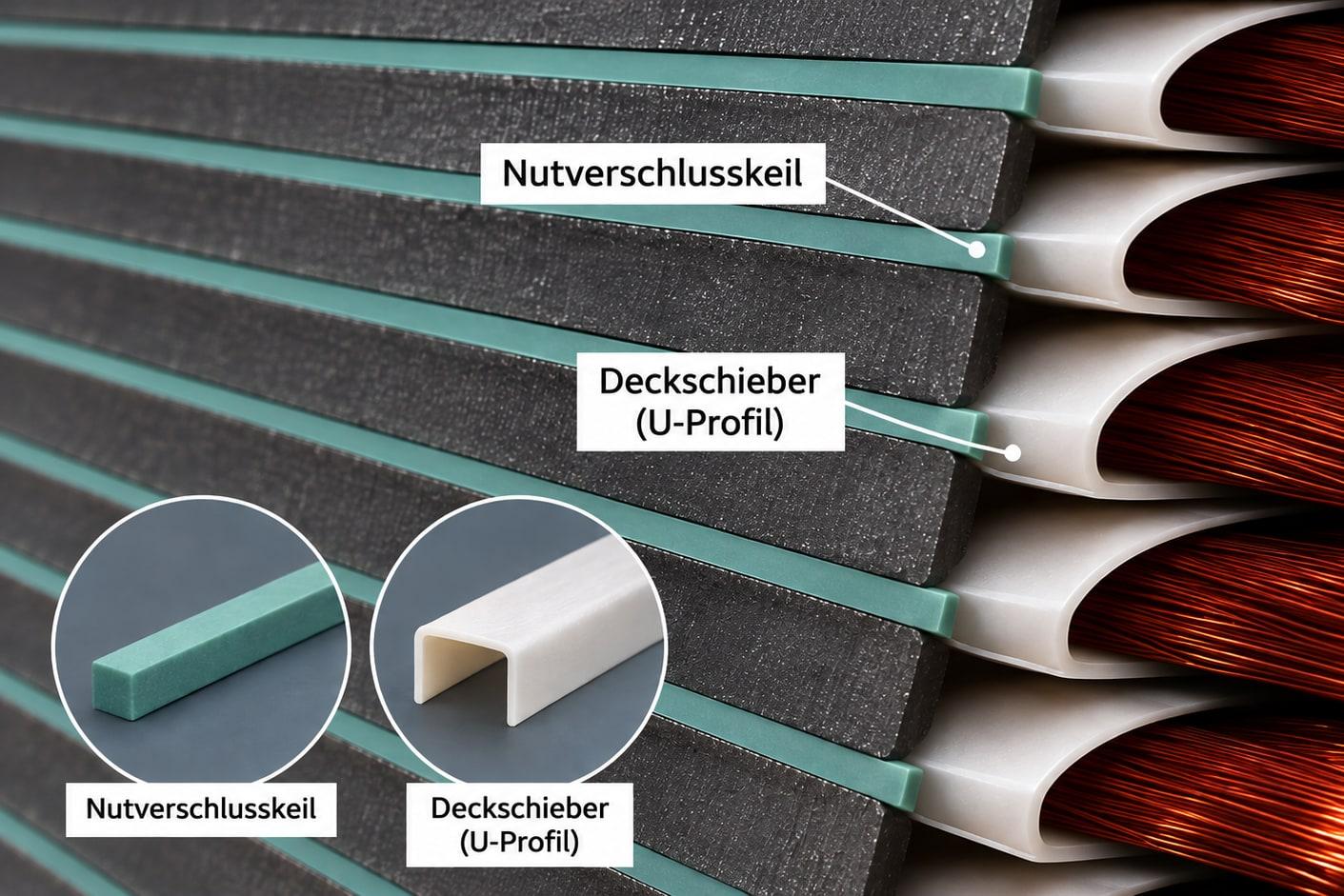
Stator with round wire winding: slot closures over the winding, topped by slot wedges, with detail circles of the slot wedge and the slot closure

A slot closure and a slot wedge both close the slot in a stator or rotor after winding, but they differ in material and function. The slot closure is a folded profile made from sheet insulation that covers the winding and keeps it in the slot. The slot wedge is a rigid profile, often made from glass fibre reinforced epoxy laminate (EPGC), that interlocks with the slot opening and locks the winding mechanically. Which of the two is right depends on the design of the machine, not on a fixed machine size.

This article is for design engineers and buyers at motor and generator manufacturers and for rewinding shops. It covers what speaks for a slot closure and what for a wedge, when the two are combined, which wedge profiles and materials exist and what magnetic slot wedges do differently. For the overall build-up, see where slot closures and wedges sit in the stator.
Slot wedge (top stick) vs slot closure: the difference

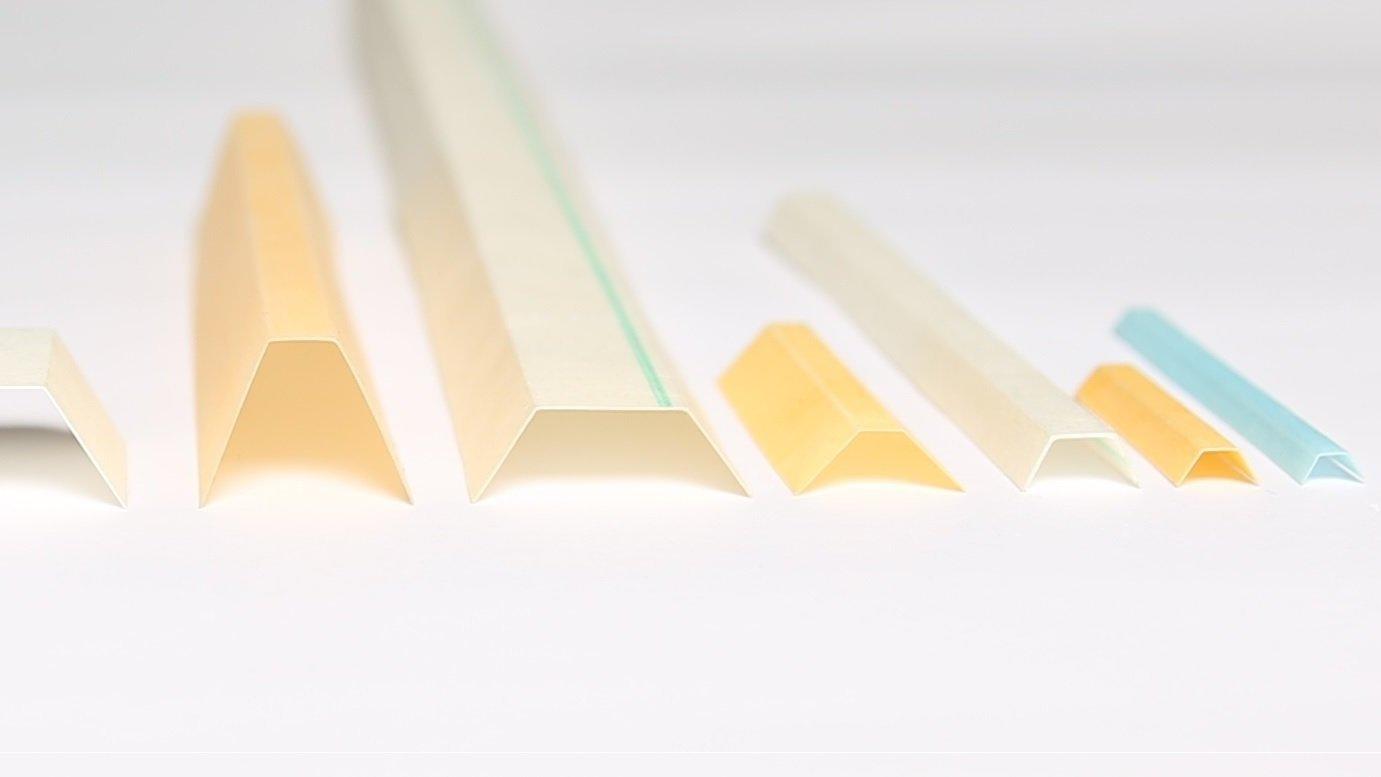
A slot closure, also called a slot cap, is a folded profile made from dimensionally stable sheet insulation or laminate in thermal classes B to H, for example Mylar® polyester film for class B or NPN laminate for class F. After winding it is pushed into the slot opening, closes the slot at the top and, among other things, keeps the wire from working its way back out of the slot. A U-profile slot separator looks similar but sits deeper in the slot between two winding layers, see U-profile slot separators in double-layer windings.

A slot wedge is a solid component with a defined cross-section. It interlocks with the slot opening, carries mechanical load and holds the winding tight in the slot: against the electromagnetic forces that pulsate at twice the frequency of the winding current in operation, against the high forces of a short circuit, against vibration and, in rotors, against centrifugal force.

English terminology is not uniform. Folded closures are often sold as paper slot wedges, and in North American repair shops the rigid part is commonly called a top stick. In this article, slot closure means the folded part and slot wedge the rigid profile. Put simply, the slot closure covers the winding and the wedge locks the slot. The two do not exclude each other, and some designs use both.

Slot closures as folded roof-shaped profiles in different sizes and materials

At what machine size do you need a slot wedge?

There is no fixed threshold; winding type and mechanical load decide.

Slot wedges are widespread in generators and high-voltage machines. Besides electrical insulation, the mechanical securing of the winding in the slot matters most there. Large generators also often use form-wound coils or Roebel bars, which are insulated before insertion and placed in open slots. The slot is then closed with a wedge instead of a folded closure. How these windings are built up is explained in our article on insulating Roebel bars and form-wound coils.

In conventional electric motors with round wire windings, the folded slot closure is the usual choice. A cover strip or wedge is added when the design calls for additional mechanical securing.

“There is no fixed machine size above which a slot wedge is used. Whether a slot closure, a slot wedge or a combination of both is used depends on the type and design of the specific machine.”

Yannick Wille, Managing Director

When the slot closure slips: securing the slot with a wedge

A slot closure only holds if it sits tightly in the slot. If the slot still has too much play after winding, it can slip.

If the fit of the slot closure alone is not enough, additional mechanical securing is needed, for example a slot wedge. This leads to a possible combination: first a slot closure is placed over the winding, then a slot wedge closes the slot mechanically. Because both parts sit one above the other at the top of the slot, their dimensions have to be matched in the drawing. Which other dimensions belong on such a drawing is covered in our article on distances and overhangs on insulation parts.

“If, for example, a slot closure does not sit tightly enough because there is still too much play in the slot, it can slip. In such cases additional mechanical securing, for example with a slot wedge, may be necessary.”

Yannick Wille, Managing Director

Slot wedge profiles: trapezoidal, semicircular or rectangular

The geometry of a slot wedge follows directly from the slot geometry of the lamination stack. There is therefore no standard profile but a wide range of designs: trapezoidal wedges and dovetail profiles that slide into the matching slot opening, semicircular and rectangular wedges, and flat wedges for open slots.

Width, height and flank angle are decisive. They have to match the slot exactly, otherwise the wedge does not interlock properly. The length follows the core. Chamfers or lead-in bevels can be added for assembly, and split wedges are possible for long cores.

“What matters is the interaction between the slot wedge and the lamination stack or slot geometry. The wedge has to match the slot geometrically, because it is meant to interlock with the slot and secure the winding reliably.”

Yannick Wille, Managing Director

Stator slot wedge material: EPGC and magnetic slot wedges

Slot wedges must sit firmly in the slot and must not shift in operation. Besides geometry, the mechanical stability of the material is therefore decisive. High-strength materials based on EPGC, that is glass fibre reinforced epoxy laminates, are common for thermal classes F and H. They offer high flexural strength and good resistance to impregnating resins. For lower requirements, polyester glass laminate is used.

Magnetic slot wedges are a special variant. Their material contains magnetically active components such as iron particles. The wedge then does more than a mechanical job and also influences the electromagnetic properties of the machine: it partly bridges the slot opening magnetically, smooths the air gap field and can reduce harmonic losses and noise. Magnetic wedges are mainly used in machines with open slots and high efficiency requirements. The trade-offs are higher slot leakage and lower mechanical strength than plain glass fibre wedges. We supply magnetic wedges through a partner.

Whether that trade-off is worth it is decided by the electromagnetic design of the machine.

Decision guide: slot closure or wedge for your machine

Five questions settle which way to close the slot. First, the winding type: round wire windings are usually closed with a folded slot closure, form-wound coils and Roebel bars in open slots with a wedge. Second, mechanical load: if high forces from short circuits, vibration or centrifugal force act on the winding, it needs load-bearing securing. Third, fit: if the slot has play after winding, a wedge over the slot closure secures the assembly.

Fourth, electromagnetics: if the slot opening is to be bridged magnetically, only a magnetic wedge will do, with the compromises in leakage and strength described above. Fifth, assembly: a chamfer on one or both sides makes insertion into the wound core easier.

For a quotation, purchasing needs, for a slot closure, the slot top geometry with back width and leg length of the profile, the thermal class, the core length and the chamfer requirement. For a slot wedge it is width, height and flank angle of the slot opening, the core length, the thermal class and whether the wedge should be magnetic. A drawing or a sample part is sufficient.

Slot closures and slot wedges from Hauler & Hermann

We form slot closures on machines we build ourselves and cut them to length without damaging the profile. A closure crushed during cutting jams on insertion or sits too loosely in the slot, so a clean profile is the precondition for a tight fit. We carry slot wedges in our range to complement our insulation parts, cut to match the core, chamfered and supplied together with the other insulation parts for the same machine. An overview of these parts is on the page insulation parts for generators.

Do you have a specific requirement?

Talk to us. We will find the right insulation solution.

Frequently asked questions

What is the difference between a slot wedge and a slot closure?

A slot closure is a folded profile made from sheet insulation that covers the winding and keeps it in the slot. A slot wedge is a rigid profile, usually made from glass fibre laminate, that interlocks with the slot opening and locks the winding mechanically. Some designs use both together.

Is a top stick the same as a slot wedge?

Usually, yes. In North American usage, top stick refers to the rigid strip that closes the slot, which this article calls a slot wedge. Because folded closures are also sold as slot wedges, the drawing should always define the profile and material.

Can a slot closure and a slot wedge be combined?

Yes. First a slot closure is placed over the winding, then a slot wedge closes the slot mechanically. This makes sense, for example, when the slot still has play after winding and the slot closure alone could slip.

What material are stator slot wedges made of?

Often EPGC, that is glass fibre reinforced epoxy laminate, for thermal classes F and H. Polyester glass laminate is used for lower requirements. Details are on the slot wedges product page.

What is a magnetic slot wedge?

A slot wedge whose material contains magnetically active components such as iron particles. It secures the winding mechanically and also partly bridges the slot opening magnetically, which smooths the air gap field and can reduce harmonic losses. In return, slot leakage rises and strength is lower than with a plain glass fibre wedge.