

Hauler & Hermann
Back to knowledge
Technical Insight

Roebel Bars and Form-Wound Coils: How Large Generators Are Insulated

Yannick Wille

By Yannick Wille, Managing Director

October 27, 2026

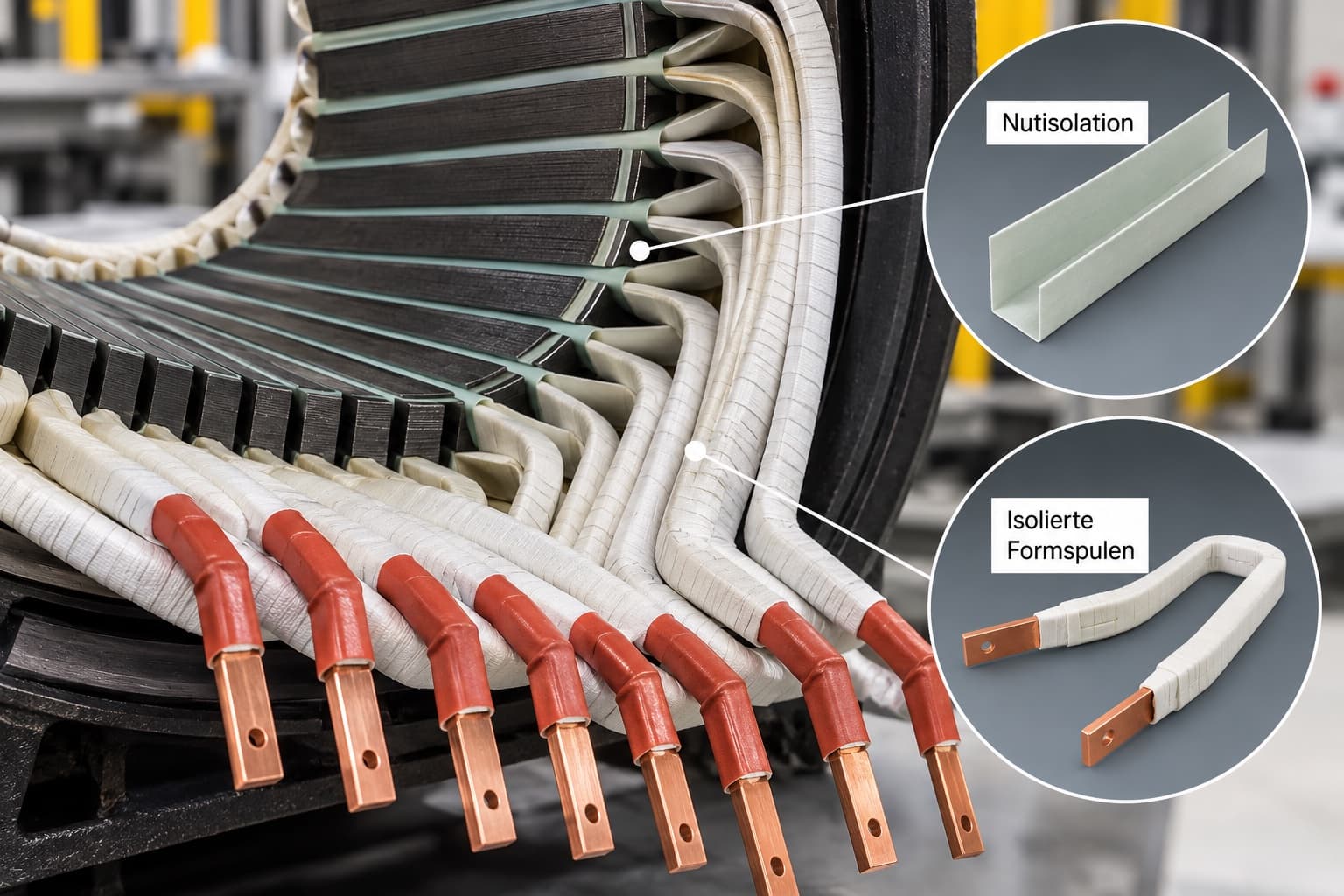
Large generator stator with insulated form-wound coils and red connection ends, close-ups showing slot insulation and insulated coils

A Roebel bar is a type of stator bar: a preformed conductor bar for the stator winding of large generators such as turbo and hydro generators, made of many strands that are insulated from each other and transposed along the bar. The transposition, named after Ludwig Roebel, moves each strand through every position in the conductor cross-section over the length of the slot. All strands therefore see the same induced voltage, circulating currents between them are suppressed and additional losses stay low. Roebel bars and form-wound coils receive their main insulation, usually mica tape, before they go into the slot.

This article is for design engineers and buyers at generator manufacturers and for workshops that overhaul large machines. It explains how form-wound coil insulation differs from a round wire winding, whose parts are covered in our overview of stator winding insulation parts, which tapes and laminates are used, and how VPI and resin-rich differ.

Roebel bar vs round wire: what is different in a large generator

In a large generator the stator winding is not wound into the slot from round wire but assembled from preformed form-wound coils or Roebel bars. In a conventional electric motor many individual layers of wire are placed in the slot to achieve the highest possible slot fill factor, and in series production this is largely automated.

Form-wound coils and Roebel bars, by contrast, consist of preformed rectangular copper conductors, subdivided into many strands in a Roebel bar. They are placed in open slots. The slot is then closed with a slot wedge rather than a slot closure. Because the main insulation is already applied at insertion, copper cross-section, insulation and slot geometry have to match at the design stage.

“While conventional round wire windings can be produced largely automatically in series production, the large form-wound coils are placed into the slots provided for them after they have been insulated. On large machines this step is often done manually and, because of the size, sometimes by two people.”

Yannick Wille, Managing Director

Form-wound coil insulation: taping with mica tape

The main insulation of a form-wound coil is usually created by taping: a mica-based tape is wrapped around the bar or coil with an overlap. Mica is particularly resistant to partial discharge and is therefore indispensable in high-voltage insulation. In high-voltage bars the insulation system also includes slot and end corona protection: conductive and semi-conductive layers that prevent surface partial discharge in the slot and at the slot exit.

Depending on the insulation system, different mica tapes are used, with backings of PET film, polyimide film or glass fabric. Tapes without mica are added as well, such as woven polyester tape and glass fabric tape. Common widths are 15, 20, 25 and 30 mm.

In OEM series production, machines do the taping, for example the Flat Coil Taping Machines made by Micamation. They wrap the insulating tape around the form-wound coil automatically and in a defined way. In repair work, form-wound coils and Roebel bars are often taped by hand. Repair is about individual large machines whose value justifies rewinding or an overhaul far more readily than with small motors.

Mica laminate slot cells: the second insulation build-up

Besides taping, there is a build-up in which mica is part of a multi-layer laminate. One example is Nomex® / mica / PET / Nomex, meaning aramid paper on both outer faces with mica and polyester film inside.

Such laminates are made into large slot cells folded to match the slot geometry. They are placed around the form-wound coil in several layers or inserted into the slot as additional insulation. A slot cell covers only the slot section; outside the slot the bar still needs continuous insulation. Folded insulation parts in long lengths are our core competence, see folding, forming and bending. Whether a particular slot cell can be made as a folded part we clarify from your drawing.

“Whether conventional taping of the Roebel bar is additionally required with this build-up depends on the insulation concept of the respective machine manufacturer. As the manufacturer of the insulation parts, we do not prescribe the build-up here, but produce according to the customer specification.”

Yannick Wille, Managing Director

VPI vs resin-rich: what is the difference?

VPI and resin-rich are the two insulation concepts that matter most for high-voltage windings. They differ in when the resin gets into the insulation.

VPI (Vacuum Pressure Impregnation) starts with an insulation system that can still absorb resin, for example porous mica tapes. The winding is then impregnated with resin under vacuum and pressure and cured. Depending on the production concept, the complete stator can be impregnated in one process, known as global VPI.

In the resin-rich process the insulation materials are already pre-impregnated with resin. Each bar and each form-wound coil is cured individually under heat and pressure and only then installed.

This choice has consequences for the insulation parts: it determines material selection, resin uptake, slot insulation and the final fit in the slot. With VPI, the parts around the main insulation, such as slot cells and fillers, have to be compatible with the impregnating resin and ideally absorb it so they bond with the winding. With resin-rich, the insulation is already cured at installation, so dimensional accuracy and fit in the slot matter most.

Which insulation parts we make for Roebel bars and form-wound coils

For Roebel bars and form-wound coils we produce slot liners from laminates and parts with non-standard geometry as special parts. We slit mica tapes to the required width and supply them on rolls.

Slot wedges are part of our supply range, cut to length to match your core. Which wedge geometries exist and when a wedge replaces a slot closure is explained in slot closure or slot wedge.

Checklist: what design and purchasing should clarify for form-wound coils

For a reliable enquiry about insulation parts for Roebel bars we need five details. First, the insulation concept, VPI or resin-rich, because it determines material and resin uptake. Second, the build-up: taping, laminate slot cell in the slot section, or both, each with the number of layers. Third, the material with layer structure and thickness. Fourth, the geometry with slot geometry, dimensions and length, recorded in a drawing. Fifth, the quantity, whether single machine, repair or OEM series.

“The dimensioning is matched precisely: copper cross-section, taping or multi-layer insulation, additional slot insulation and slot geometry have to fit together.”

Yannick Wille, Managing Director

Roebel bar insulation: the key points

In a Roebel bar the insulation is not a single part but a system of mica tapes, laminate slot cells where specified, slot insulation and slot wedge that has to suit the chosen process. The earlier process, build-up and slot geometry are fixed, the more precisely all insulation parts can be matched to them. The full range of parts we supply for generator construction is on the insulation parts for generators page, and for wind turbines on the wind power page.

Do you have a specific requirement?

Talk to us. We will find the right insulation solution.

Frequently asked questions

What is a Roebel bar (stator bar)?

A Roebel bar is a preformed conductor bar for the stator winding of large generators, made of many mutually insulated, transposed strands. The transposition devised by Ludwig Roebel suppresses circulating currents between the strands and keeps additional losses low. The bar is insulated before it is placed in the slot, usually with mica tape. Depending on the insulation concept, mica laminate slot cells are added in the slot section.

What is the difference between a Roebel bar and a form-wound coil?

Both are preformed copper conductors that are insulated before insertion. A form-wound coil consists of several turns of a rectangular conductor and is inserted as a complete coil. A Roebel bar is a single bar of transposed strands, and the bars are only connected to each other at the end winding. Roebel bars are found mainly in the largest generators.

What is the difference between VPI and resin-rich?

With VPI the winding, insulated with resin-absorbing mica tapes, is impregnated with resin under vacuum and pressure, often the complete stator at once (global VPI). With resin-rich the tapes are pre-impregnated, and each bar is cured individually under heat and pressure before installation. The process determines material selection, slot insulation and fit in the slot.

Which mica tapes are used for form-wound coils?

Common types are mica tapes with a backing of PET film, polyimide film or glass fabric. Tapes without mica are also used, such as woven polyester tape and glass fabric tape. Typical widths are 15, 20, 25 and 30 mm. The build-up used is defined by the machine manufacturer's insulation system.

Are Roebel bars taped by machine or by hand?

Both. In OEM series production, machines such as Micamation's Flat Coil Taping Machines wrap the tape around the form-wound coil automatically. In repair work, form-wound coils and Roebel bars are often taped by hand.